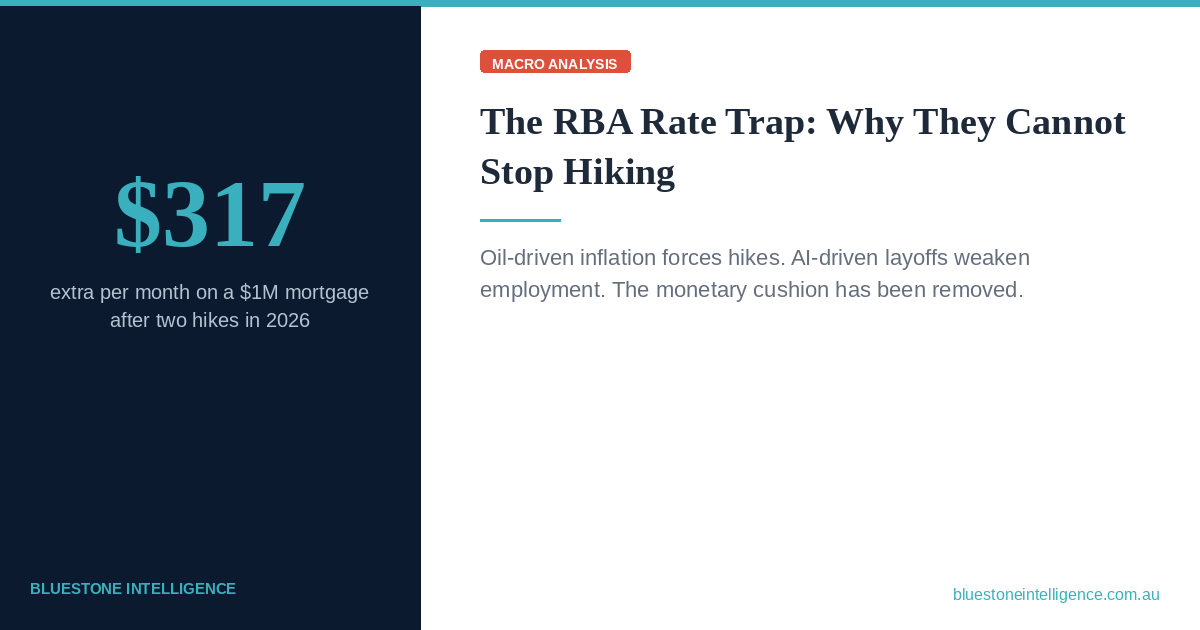
The Reserve Bank of Australia hiked the cash rate to 4.10% on 17 March 2026. This was the second hike in two months, reversing the rate cut cycle that began in February 2025.
For homeowners, the maths is straightforward. Two hikes in 2026 add roughly $317 per month to a $1 million mortgage. If the Big Four bank forecasts are correct and another hike follows in May, the total additional monthly cost reaches close to $500 compared to the start of the year.
But the rate decision itself is not the story. The story is that the RBA may be trapped.
Why They Are Hiking
Oil prices. Since the US and Israeli military operations against Iran began on 28 February, disruption in the Strait of Hormuz has pushed Brent crude above $100 per barrel, peaking at $126 in early March. Higher oil prices flow directly into Australian fuel costs, transport costs, and eventually food prices. Inflation, which was already above the RBA's target, has gotten worse. The RBA's mandate requires them to respond.
Why They Cannot Stop
Even if the geopolitical situation stabilises, oil prices take months to flow through the supply chain. The RBA's own revised forecasts show inflation not returning to the middle of the target band until 2028. With the labour market still tight by historical standards (unemployment at 4.1% in January), the Board sees domestic demand as too strong. They feel they have no choice but to tighten.
Why This Is a Trap
Here is the problem. AI-driven layoffs are accelerating at exactly the same time as the RBA is hiking. Tech companies have cut 4,450 jobs in 10 weeks. The banks are freezing hiring. Professional services firms are next. These are the high-income earners with large mortgages. They face a double squeeze: their income is becoming less secure while their repayments are going up.
Normally, the RBA would cut rates when employment weakens. That is the monetary cushion. But with oil-driven inflation running hot, they cannot cut. The cushion has been removed.
This is the mechanism our model calls the Hard Landing scenario. Not that everything goes wrong at once, but that the usual policy tools are unavailable at exactly the moment they are needed. The RBA is fighting inflation with rate hikes while AI is fighting employment. The two forces pull in opposite directions and the people in the middle, the mortgage holders with white-collar jobs, absorb the full impact.
For detail on who those mortgage holders are, read 4,450 Tech Jobs Cut in Sydney in 10 Weeks. Here's What Happens Next.
Current Model Assessment
We give a 29% probability to the Hard Landing scenario. That is up from 20% at the start of March, driven by the Hormuz disruption and the tech layoff wave. The Strait of Hormuz situation is the key variable. If it resolves quickly, the RBA gets room to pause or reverse. If it persists for six months or more, the rate path trap tightens.
To understand what this means household by household, read When One Income Disappears: The 12-Month Cascade That Nobody Models.
Full scenario analysis and sector guidance at Bluestone Intelligence.
Get AccessBluestone Intelligence provides economic scenario analysis and general information only. It is not financial advice. Consult a licensed financial adviser before making investment decisions.