Most economic analysis tracks AI displacement at the sector level. X thousand jobs cut from tech. Y percent of professional services roles at risk. These numbers are useful but they miss something important: what actually happens inside a household when the displacement hits.
We built a household cascade model to trace the downstream effects of a single job loss through the economy over 12 months. Not at the macro level. At the kitchen table level.
The same AI dynamics driving the tech layoff cascade and the RBA rate trap hit this household from both sides simultaneously.
The 12-Month Timeline
The job loss
A white-collar professional in Sydney loses their role. Specific profile: a senior developer at a tech company, earning $160,000. Married, two children in private school. Mortgage of $900,000 on an inner-city apartment. Limited savings. This profile is not unusual. Roughly half of working Australians live pay cheque to pay cheque.
The savings drawdown
The household shifts to single income. Savings absorb the gap, but the burn rate is unsustainable. Discretionary spending is cut immediately: restaurants, entertainment, subscriptions, upgrades. The local businesses that depended on this household's spending register the drop.
The school decision
Private school fees for two children can exceed $40,000 to $60,000 per year. Under financial pressure, the family defers fees or withdraws one or both children. The school loses revenue. If enough families in the catchment face similar pressure, the school faces a financial stress event. Non-elite private schools with thin reserves and recent capital works debt are most vulnerable.
The mortgage decision
Nine months of reduced income and savings depletion. The mortgage, which was manageable on two incomes, is now a crisis on one. The family considers selling. If they sell into a weakening market (because other households in similar positions are also selling), they may crystallise a loss. If they hold on, they risk arrears. The bank that holds the mortgage records the stress. Multiply this household by hundreds or thousands across inner-city Sydney and Melbourne, and the bank's provision charges start rising.
The attitude shift
After a year of financial pressure, political attitudes change. Anti-immigration sentiment rises (immigrants perceived as competing for scarce jobs). Anti-tech sentiment rises. Demands for government intervention intensify. The political environment shifts in ways that can affect regulation, migration policy, and market confidence.
Why This Matters
When we model sectors independently, the individual estimates look manageable. Banking: 8-12% headcount reduction under the central scenario. Real Estate: moderate pressure. Education: stable with some admin exposure.
But when you trace a single household through all of these sectors simultaneously, the cumulative effect is much more severe. The household hits banking (mortgage stress), real estate (property values), education (school fees), consumer discretionary (spending), and even the political environment, all from one job loss.
This is why our model includes cross-sector correlation checks. Independent sector ratings that look "manageable" can combine into something much more serious when experienced by the same household. The cascade is the mechanism that turns isolated layoffs into systemic pressure. For a full breakdown of sector ratings, see Which Australian Sectors Are AI-Proof? We Rate All 15.
Current Assessment
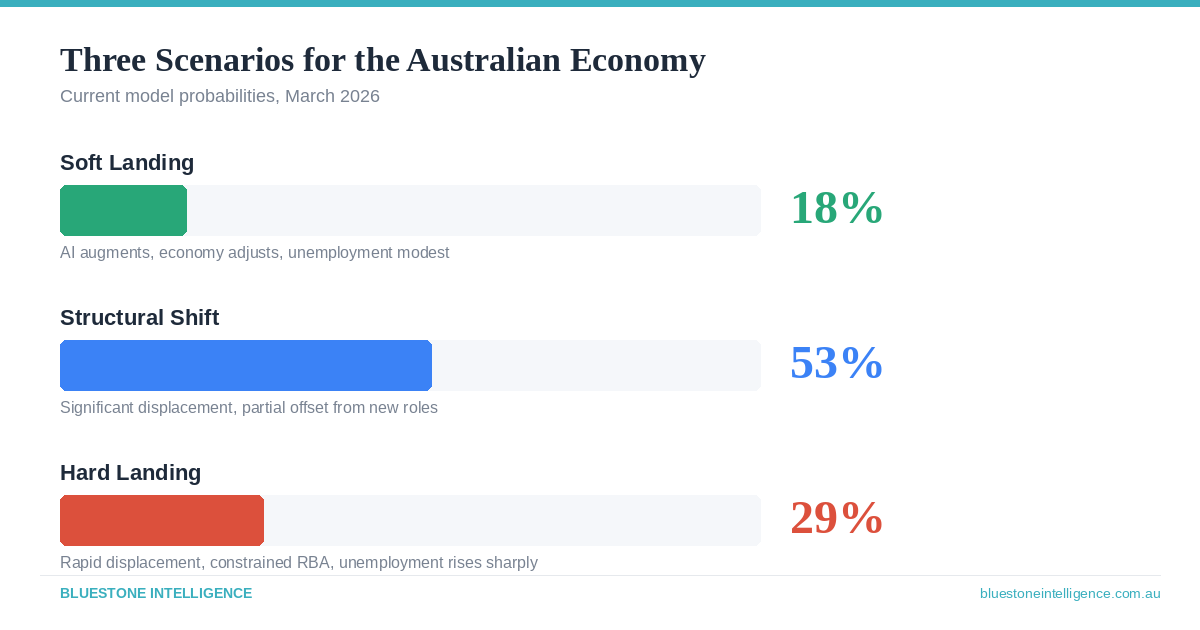
Our model gives 53% probability to a Structural Shift scenario where this cascade is visible but partially offset by new role creation and government action, and 29% probability to a Hard Landing where the cascade runs faster than the offsets. The super exposure risk makes this especially relevant for Australian households with balanced fund investments.
Full scenario analysis, sector ratings, and live monitoring at Bluestone Intelligence.
Get AccessBluestone Intelligence provides economic scenario analysis and general information only. It is not financial advice. Consult a licensed financial adviser before making investment decisions.